
WHO不推荐鱼油?鱼油“护脑神话”翻车了?
来源:CHTV百姓健康2026-09-01 19:19:13

在保健品货架上,鱼油胶囊常年占据“C位”,“护脑”“防痴呆”的标签令人心动。但世界卫生组织(WHO)最新指南给出了一个颠覆性结论:没有证据表明鱼油能预防痴呆,健康人群无需额外补充。 这意味着,花高价买来的“脑黄金”,可能只是一场心理安慰。
一、WHO真的“不推荐”鱼油吗?
2019年第一版指南已明确指出:没有强有力的证据表明鱼油等补充剂能够预防痴呆。WHO技术官Neerja Chowdhary当时表示:“目前没有证据表明服用这些补充剂实际上降低了认知能力下降和痴呆的风险,事实上,高剂量可能是有害的”。
2026年第二版指南进一步强化了这一立场,将“不推荐用Omega-3、维生素B、维生素E及复合维生素预防痴呆”列为唯一的“强推荐反对”条目。
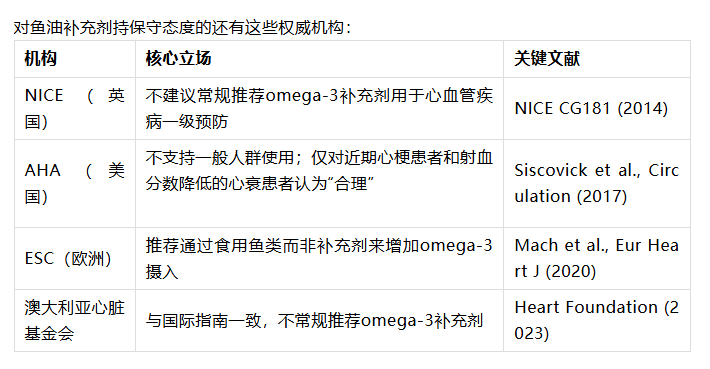
二、为什么权威机构对鱼油补充剂趋于保守?
证据格局在过去二十年发生了剧变。2002年前后,GISSI-Prevenzione和DART两项大型随机对照试验(RCT)显示鱼油能显著降低心脏性猝死,奠定了早期推荐基础。但2010年代后,ASCEND、VITAL、STRENGTH等多项大规模RCT未能重现早期结果。
2017年AHA科学声明:证据重估AHA的核心结论是:“累积的RCT证据对omega-3补充剂预防心血管事件的益处提出了质疑”。声明不支持在无高心血管风险的一般人群中使用;仅认为对近期心梗患者(可能降低冠心病死亡约10%)和射血分数降低的心衰患者(降低死亡率和住院率约9%)补充“合理”,且无法推荐用于一级预防。
- 主要心血管事件风险降低约5%(RR 0.95, 95%CI 0.91-0.99)
- 心肌梗死风险降低约10%(RR 0.90, 95%CI 0.83-0.98)
- 房颤风险风险增加25%(RR 1.25, 95%CI 1.10-1.41)
更关键的发现是:心血管获益主要归因于处方级EPA乙酯(icosapent ethyl),而非普通EPA+DHA混合鱼油补充剂。在政策层面,英国NHS于2023年将omega-3脂肪酸化合物(除icosapent ethyl外)列入”不应在初级医疗中常规处方”清单。
三、Omega-3能预防老年痴呆吗?证据矛盾重重
观察性研究:积极的信号
2024年一项基于NHANES 2011-2014数据的横断面研究(3,123名60岁以上老年人)发现,鱼类消费与即时回忆、延迟回忆和执行功能评分均呈显著正相关,即使存在铅、镉、甲基汞暴露,鱼类摄入仍与认知功能正相关。
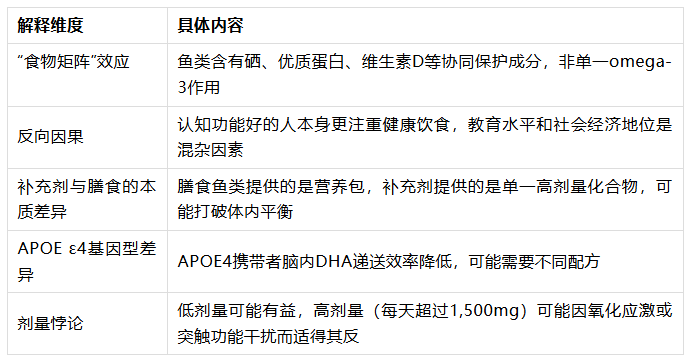
研究者认为,这可能因为鱼类作为完整食物,含有硒、优质蛋白、维生素D等协同保护成分,而非单一omega-3的作用。
随机对照试验:令人失望的结果
2026年USC临床试验:高剂量DHA的“零效应”
这项24个月的双盲RCT(365名55-80岁阿尔茨海默病高风险成人)发现,每天2g DHA确实使脑脊液DHA水平增加17%,但认知测试无改善,海马体萎缩未减缓。研究者直言:“鱼油补充剂似乎不能保护大脑健康。”
2026年ADNI纵向分析:意外的“加速衰退”信号
基于阿尔茨海默病神经影像学倡议(ADNI)数据库的纵向分析发现,omega-3补充与认知衰退加速相关——MMSE评分下降更快,ADAS-Cog13和CDR-SB评分恶化更快。机制分析显示,这一关联由脑内FDG低代谢(突触功能障碍)介导,占总体效应的19%-41%,而非由Aβ沉积或tau病理介导。
2025年系统综述:微弱且不一致的效果
一项纳入14项RCT、26,881名参与者的系统综述发现,omega-3对MMSE评分有统计学显著但微弱的改善(效应量0.16),且无剂量-反应关系,提示“阈值效应”——脑内DHA转运蛋白饱和后,额外补充不再获益。
Cochrane系统综述的结论更为直接:“没有足够的高质量证据表明omega-3补充剂能预防认知衰退或痴呆”。
五、实践参考
- 每周2-3份鱼类(每份150-200g),至少1份为富含脂肪鱼类(鲑鱼、鲭鱼、沙丁鱼、鲱鱼、鳟鱼),通过饮食获取每日250-500mg EPA+DHA
- 鱼油胶囊不等于吃鱼。市售普通鱼油补充剂缺乏心血管或认知保护的可靠证据
- 处方级icosapent ethyl仅适用于已确诊ASCVD且甘油三酯偏高的患者,需在医生指导下使用并监测房颤风险
- 对于认知健康,地中海饮食模式、体力活动、睡眠优化和认知训练的综合策略,证据远强于单一营养素补充
参考文献
1.Food and Agriculture Organization of the United Nations/World Health Organization (FAO/WHO). Report of the Joint FAO/WHO Expert Consultation on the Risks and Benefits of Fish Consumption.
2.National Institute for Health and Care Excellence (NICE). Lipid modification: cardiovascular risk assessment and the modification of blood lipids for the primary and secondary prevention of cardiovascular disease. NICE guideline [CG181]. 2014.
3.Siscovick DS, Barringer TA, Fretts AM, Wu JHY, Lichtenstein AH, Costello RB, Kris-Etherton PM, Jacobson TA, Engler MB, Alger HM, Appel LJ, Mozaffarian D. Omega-3 polyunsaturated fatty acid (fish oil) supplementation and the prevention of clinical cardiovascular disease: a science advisory from the American Heart Association. Circulation. 2017;135(15):e867-e884. doi: 10.1161/CIR.0000000000000482
4.Mach F, Baigent C, Catapano AL, Koskinas KC, Casula M, Badimon L, Chapman MJ, Backer GG, Delgado V, Ference BA, Graham IM, Halliday A, Landmesser U, Mihaylova B, Pedersen TR, Wiklund O, Wilkins GT, Zamorano JL, Vlachopoulos C, Authors/Task Force Members. 2019 ESC/EAS Guidelines for the management of dyslipidaemias: lipid modification to reduce cardiovascular risk. Eur Heart J. 2020;41(1):111-188. doi: 10.1093/eurheartj/ehz455
5.Heart Foundation of Australia. Fish, seafood and heart health. Nutrition Position Statement. Updated 2023.
6.Bernasconi AA, Wiest MM, Lavie CJ, Milani RV, Laukkanen JA. Efficacy and safety of omega-3 fatty acids in the prevention of cardiovascular disease: A systematic review and meta-analysis. JAMA Netw Open. 2022;5(1):e2141088. doi: 10.1001/jamanetworkopen.2021.41088
7.PrescQIPP. Omega-3 fatty acid compounds and other fish oils. Bulletin 343. Version 2.0. 2023.
8.Sasaki N, Yamashita H, Yoneda M, et al. Fish consumption and omega-3 polyunsaturated fatty acids from diet are positively associated with cognitive function in older adults even in the presence of exposure to lead, cadmium, selenium, and methylmercury: a cross-sectional study using NHANES 2011-2014 data. Am J Clin Nutr. 2024;119(2):456-466. doi: 10.1016/j.ajcnut.2023.12.007
9.Yassine HN, Feng T, Aziz K, et al. CNS target engagement of high-dose DHA supplementation in older adults at risk for dementia: a randomised, double-blind, placebo-controlled trial. eBioMedicine. 2026;111:105428. doi: 10.1016/j.ebiom.2026.105428
10.Liao ZB, Hu ZC, Zeng GH, Chen J, Li XP, Liu YH, Yao XQ, Wang YR, for the Alzheimer's Disease Neuroimaging Initiative. The association between omega-3 supplementation and cognitive decline in older adults. J Prev Alzheimers Dis. 2026;13(6):100569. doi: 10.1016/j.tjpad.2026.100569
11.Barros MI, Brandão T, Irving S, Alves P, Gomes F, Correia M. Omega-3 polyunsaturated fatty acids and cognitive decline in adults with non-dementia or mild cognitive impairment: an overview of systematic reviews. Nutrients. 2025;17(18):3002. doi: 10.3390/nu17183002
12.Burckhardt M, Herke M, Wustmann T, Watzke S, Langer G, Fink A. Omega-3 fatty acids for the treatment of dementia. Cochrane Database Syst Rev. 2016;(4):CD009002. doi: 10.1002/14651858.CD009002.pub3.
本文内容仅供健康科普参考,不构成诊疗建议。如有不适,请及时就医。

 CHTV 百姓健康微信